End of Mosquito Huntin' Season

By Howard Williams

Last year, the Mosquito Abatement Courier season closely paralleled the baseball season in San Francisco. On Friday, October 30, 2010, we dropped our last packet of larvicide into a catch basin and three days later, the San Francisco Giants won their first World Series.


This year the injury plagued but gritty Giants were finally eliminated from the playoffs in September while our mosquito abatement season continued well into autumn.


As we approached the end of October, the team heard different dates for the finish of the season. In previous years the last Friday of October had marked the season's completion. And since 2008, that day had also been the last weekday of October. But this year the last weekday was Monday the 31st. So would we finish on Friday the 28th or Monday the 31st ? Or would we work into November ? That had happened before but it was rare.


On the 24th we learned that the season would go at least to the 31st.


In addition to being very strenuous, mosquito abatement courier work requires early rising. By the end of October, the sun is rising after 7 AM while we are still getting up before 6. This combination of waking in the dark and then working hard all day can be tough. The Old Veteran noticed this but so did the younger riders. As October continued, our productivity took a slight decline. Yet morale stayed strong and our accuracy actually improved. Still, a few riders admitted that they were looking forward to "those lazy, hazy, crazy days" of winter, those days of turkey, pumpkin pie and  mulled wine.


And why not ? Autumn and winter are natural times of rest and slowed activity. Trees lose their leaves, plants become dormant, animals retreat to their lairs and hibernate. Even that great storehouse of energy the sun, seems to work less. It gets up late, stays low in the southern sky and "rests" early. Here in the Northern Hemisphere, the ancients really thought it was taking a break but we now know it's just moving summer to the Southern Hemisphere. Nevertheless, this time of year, the sun's energizing presence is seen and felt less in these parts. So it's only natural that we humans also find more time for rest. What energy we have is often offered to or received from each other, either in the form of food or in conversation and entertainment.


Mid-October saw a brief Indian Summer when mid-day temperatures climbed into the 80s. But by late October, the air had cooled with no more hints of summer, Indian or otherwise.


The last full week of October went by routinely. The Old Vet conserved his strength but still worked enough to keep pace with his colleagues.


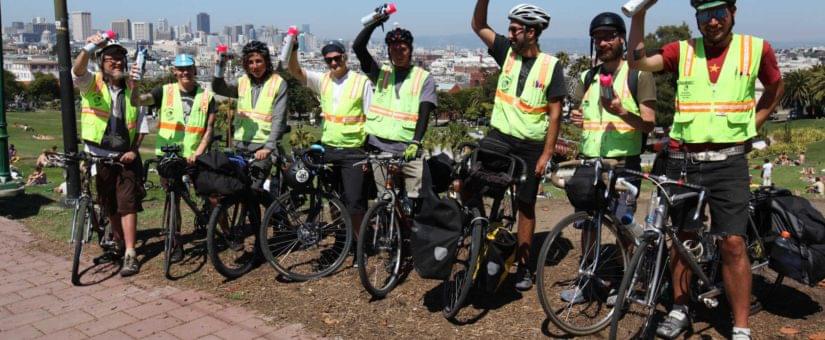
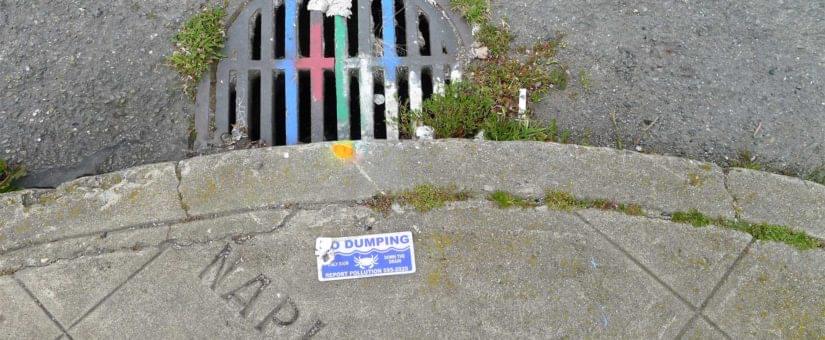
On Monday the 31st, the team rode together to various parks in the City to find "tricky" catch basins. Tricky CBs are those that are well hidden, sometimes under shrubbery or in places where they are not usually found. By working as a group, we all would see CBs that some of us might not find on our own. By learning as a team, each of us could then find these tricky CBs in the future.


We started from our base in Bayview - Hunters Point and rode north along the waterfront. In the Dogpatch neighborhood, we stopped for coffee and pastries at the Jolt n' Bolt, a small cafe in an office building. To the Old Vet this cafe was special for something that had happened almost ten years ago. He had been a bicycle messenger at the time and on a sunny afternoon had delivered in the office building. He went downstairs to the cafe and was finishing a snack when his dispatcher called and ordered him to the Bayview. For some reason, he hesitated. He wasn't feeling lazy and had no qualms about the order. He just didn't feel like going at that moment. He took his time, then left to go to the Bayview.


As he rode south on Third Street, he saw two police cars parked near another car. The third car was cordoned off by a strip of yellow tape reading "Police Line - Do Not Cross." He swerved around the obstacle and continued on without any more interest in the scene.


The next day he read in the paper that two men had been fatally shot in that car ... at about the same time that he would have been there had he immediately responded to his dispatcher's call.


We finished our coffee and pastries and resumed our ride along the waterfront, finding a few tricky CBs. At the Ferry Building we turned inland, passing Occupy San Francisco and going to Victoria Manalo Draves Park in the South of Market neighborhood. Named for San Francisco's Filipina American Olympic gold medal diver, the small park is notorious for its tricky CBs. Except for those familiar with the park, it was extremely challenging to find some of the catch basins.


Before leaving the park, our supervisor Bryan received a text stating that Monday, November 7, would be  our last day. We finally had a definite schedule. Some of the crew had given notice so this was the last day in 2011 that we would all be together. For the rest of the week, there were only four to six of us each day.


We spent the rest of the day locating CBs in other parks, including Golden Gate. On the way back we stopped at the bike mural near Market and Duboce Streets. This mural by Mona Caron portrays a variety of San Francisco biking scenes and even depicts a CB with a MAC crew mark. Former crew member David Kimberling reported that when Mona was told about the MAC team's work, she painted the mark herself.


The next day, Tuesday November 1, was bright and pleasant. But the Old Vet noticed some differences. In mid-morning, a gentle but cool wind blew in from the east, temporarily chilling the air. And as he headed into base he felt a chilly breeze from the north. Most winds in San Francisco are westerlies, especially in summer. Cool winds from the inland and the north are changes of weather and of the season.


And this day the sun's warmth began to feel different. It's difficult to describe the warmth of autumn and winter sunshine. Recently, the Turkish-American writer Elif Batuman of San Francisco cited a poet whose verse was about "how you're never sure what nature is telling you but it's definitely telling you something." Maybe the sun's warmth in colder seasons is something like that.


Near the end of year, the sun drifts across the southern sky in a low arc. Its light is usually mellow, almost tempting us to stare right at it. But this mellow winter sun can be deceptive; in late afternoon, as cyclists and drivers proceed west on Market Street, it shines straight into their eyes.


Wednesday the 2nd was also sunny and pleasant.  The day was routine except for another sign that the season was changing: Christmas decorations in a store window.


On Thursday the 3rd, it drizzled. It was uncomfortable but not enough to stop the day's work. It seemed much like a San Francisco summer drizzle but reminded us that, unlike summer, San Francisco would get much more heavy weather in the coming months. Friday was sunny again and our last full day. The Old Vet surprised himself - and probably others - by setting a personal record for CB inspections.


On the weekend we turned our clocks back an hour and were able to get up easily on Monday morning and charge into work. But it was only a half day. Around 12:30 we were called back into base. By 1 PM we had all clocked out.


Mosquito abatement season was over.


In 2011, the Pestec Mosquito Abatement Courier (MAC) team reached a new pinnacle in our history. We worked from February 15 to November 8, one of our longest seasons ever. By the end of the season, we had completed 13 rounds (coverages of San Francisco). Well before November, we had completed more rounds than any other previous MAC team. We had accomplished this even though we had endured more rain days than most previous MAC teams.


The season's final days reminded us that despite all the impact humans have on the environment, weather can be strong even in subtlety.
 

Howard Williams is a Vetearn MAC Team Member.

MosquitoSF.com is the official Site of the SF Mosquito Bikers Powered by Pestec


CATEGORY: Mosquito

Eating on the Job

By Howard Williams, Veteran MAC Team Member


A poster at a company I once worked for echoed the warning of Captain John Smith's warning to the Jamestown, Virginia settlers of the early 1600s : "You don't work, you don't eat !" That's true but even more so is the reverse : You don't eat, you can't work.


While researching Urban Flow, his 2011 sociological study of bicycle messengers, Jeffrey Kidder took a job as a bike messenger. Soon he developed what is called a "courier's appetite."


Because Mosquito Abatement Courier work is even more strenuous than messengering, we also need to eat in quantity -- and quality. For hard work, eating well is more than an esthetic matter. Good food in generous amounts fuels us for the job.  We usually pack our lunches but there are some special places we like to go to for our meal break.


An earlier article on this blog mentioned that, in addition to mosquito abatement, MAC workers perform other public services. In that spirit, this article will mention three places that offer generous amounts of good food at reasonable prices. Future articles will mention other quality dining places.


Wendy's


No, not the Wendy's that sells fast food that tastes the same as their competitors in the restaurant chain industry. This is Wendy's Cheesecake Bakery, a family owned bakery and diner at 3rd and Quesada in the heart of the Bayview/Hunters Point district. Although tiny, Wendy's carries a wide variety of stick to your rib foods. They're rightly famous for their cheesecake but also try their pecan pie. Many other pecan pies are too sweet and gooey. However, Wendy's pecan pie fillings have a hearty taste and firm texture. Their popular  bread pudding is sweet and spicy.


In addition to these and other pastries, Wendy's offers Southern cuisine fish, chicken, pork and beef dishes along with a dozen flavors of ice cream, all at reasonable prices.


The jukebox carries a wide range of soul music classics. The small dining space is decorated by awards and newspaper articles along with a few knick knacks. There is a friendly ambience that often overflows into the street. As a result, I never need to lock my bike there.


El Toro Taqueria 


"In 7A all roads lead to El Toro." The MAC team's Map 7A includes the Mission District with many locally famous taquerias. A favorite one for us is El Toro at the corner of 17th & Valencia.


El Toro presents a wide variety of Mexican food at fair prices. But when someone really needs to stretch a few dollars, it's good to order a side dish, such as black beans or grilled mushrooms, then stroll over to the salsa bar and sample a distinctive condiment. Tortilla chips come with side dishes so you can try another salsa on your chips.


I like to order the brown rice which is fluffy yet savory. At the salsa bar, I mix in a little bit of jalapenos in vinegar. That may sound dangerous but it's only "medium hot" so the unique flavor isn't burned out. In addition to green and red salsas, the bar also carries limes. Along with a large agua fresca, chips and rice (or beans) makes a good lunch for less than $ 5


From 3 to 5 P.M. on weekdays is happy hour when tacos are only a dollar.


Mandalay Restaurant


Located in the Richmond District on California Street near 6th Avenue since 1984, Mandalay Restaurant is America's first Burmese restaurant. Burmese cuisine is influenced by Indian, Chinese and Thai cooking. Rice is the staple and Mandalay offers fried rice as well as four different side orders for rice : white, brown, saffron and coconut rices.


Unlike most other restaurants we prefer, Mandalay is a little pricey. It's certainly reasonable compared to other "fancy" restaurants but eating there does require a little extra funds. Going with someone else and splitting your orders will make the meal more economical.


Their seafood dishes are excellent, especially the Rangoon Three Ingredients.  Mandalay is well known for their unique salads. Tea leaf salad features tea leaves mixed with lentils, peanuts, hot peppers, sesame seeds, fried garlic and ground shrimp. The ginger salad is similar with ginger used instead of tea leaves. The rainbow salad has twenty ingredients. There are also mango, papaya and chicken salads.


A good plan is to go with a friend, order an entree and salad and split them. But you may want to save room for dessert. Burmese desserts use traditional yet distinctive ingredients such as agar, tapioca and mango as well as those more familiar to American palates such as ice cream and bananas.


Howard Williams is a Veteran MAC Team Member


The Mosquito Bikers are Powered by Pestec.


Meet Erin West the MAC Team Supervisor - Nature and Culture

This is the first post in a special series being done by Pestec's Health Related Services Manager Erin West. In this series Erin West will share her educational background and perspective and the positive benefit it has brought to her roles at Pestec, an innovative reduced-risk pest management company.


Later blogs will discuss Erin's role as the manager of our Mosquito Abatement Courier Team, her connection with Pestec's founder Luis Agurto Sr.'s One Tree One Forest project, and other synchronous bio-friendly pest management "by-projects." Please say hello to Erin West...


Nature and Culture


In 2007 I graduated from the University of California, Davis with a degree in nature and culture.  The Nature and Culture program was a part of the humanities department at UCD and was the first of its kind in the country. Interweaving the natural sciences, humanities and the social sciences, the program allowed me to study in a variety of disciplines and departments. I chose an emphasis heavy in the biological and environmental sciences with courses such as conservation ecology, California flora and fauna and wildlife biology. The beauty of the Nature and Culture is in the diversity of courses which comprise the program.


To most, looking at the Nature and Culture program might not seem like much. My graduating class was under 20, and the entire program itself had no more than 100 students. However, like we all have been told before, size doesn’t matter. In fact the small size of the program allowed for an unheard of teacher to student ratio of 5 to 1. In any public university, including UC Davis, it is not uncommon to be in a sea of hundreds of students while a single professor atttempts to explain, along with half a dozen teaching assistants, such complicated subjects as organic chemistry or multivariable calculus. While large courses were inevitable with most larger programs the Nature and Culture program purposely kept their class size small which lead to more engaging and focused discussions.


I feel privileged to have been a part of the Nature and Culture program, especially since as of June of this year it has been discontinued. As state funding for California’s universities has dramatically declined, schools have reduced financial aid, hiked up tuition fees and cut valuable programs such as the Nature and Culture major. Hopefully one day the program will return to UC Davis and another lucky group of students will experience the uniqueness that was embraced by many and remembered by all.


By Erin West


MosquitoSF.com is the offical blog of the SFPUC MAC Team Powered by Pestec Integrated Pest Management.


CATEGORY: Human Health

Beth Sets Pestec Record in Southeast Neighborhoods

By Howard Williams, Veteran MAC Team Member


On August 18, Beth Ann LaBerge, a rookie on the Mosquito Abatement Courier crew, set a record for covering the most area in one day by a MAC team member.


In just under eight hours, she covered almost all the Portola District along with the Alemany Farmers' Market and the steep southeast slope of Bernal Heights. What made this feat even more impressive was the fact that it was done by a rider in her first year. The crew was so amazed that a veteran rider was sent out the next day to inspect her area. He reported only two minor errors which were easily corrected.


Beth did have some advantages. The territory is near Pestec's Bayview office so she was able to access her area quickly and then had an easy, flat route back to base. This minimal "commute" to and from her assigned neighborhoods gave her plenty of time to concentrate on her task. The weather that day was mild and traffic was light throughout most of her area. Only when she left the Portola to negotiate Alemany Boulevard over to Farmers' Market did she encounter heavy traffic. There she slowed down enough to assess the situation and cross over to the Farmers' Market parking lot. Not only did she experience light vehicular traffic, there were also few pedestrians throughout her area. Fewer pedestrians also means  more street crossings will be clear.


Beth's performance highlights again the advantages of using bicycles for mosquito abatement. Even with two people, it would require a motor vehicle almost a week to cover the same amount of territory. A truck crew can not equal the average MAC bicyclist, let alone one who is setting a record. And the numerous stops and starts that our job demands means that even a small car would not only be less productive; it would also leave a massive carbon "footprint." Also, bicyclists are better able to meet the public and explain the mosquito abatement program than those inside vehicles.


It's always tempting to ask if a record can be broken. I think Beth's can but not readily. The advantages she utilized so effectively can appear again for another MAC rider but probably not for awhile. The biggest and most important barrier to breaking such a record is the need for accuracy on the job. No matter how much area a MAC rider is covering, no matter how fast he or she may ride, the MAC team member knows that the first goal of the job is accuracy.


CATEGORY: Biking

Chert: The Original San Francisco Rock Star


By Howard Williams, Veteran MAC Team Member


As famous as the City's cable cars and bridges is her unique natural history. Fog shrouded hills and winds sweeping in from the vast Pacific are as familiar to us as the structures built by humans. Though not as famous as the fog and sea, the sedimentary rock known as radiolarian chert is literally what the City is built on. 


Chert is a sedimentary rock found over much of the world but it has a special place - or rather, several special places - in San Francisco. 


Chert comes in a variety of forms and colors. Here in the Bay Area, the two most common colors are reddish brown and dark gray. Probably the most familiar example is the outcrop of reddish chert folds on the west side of O'Shaughnessy Boulevard above Glen Canyon


Not as familiar but more impressive is the steep chert massif on the east side of Corona Heights. Rising over fifty feet perpendicularly above a children's playground, this huge gray block gives Corona Heights its other name : Rocky Mountain. This naturally made monument is a textbook example of slickenside, a word that means just what it sounds like : a polished rock surface. Slickensides are caused by the frictional grinding of earthquake activity. As you look at the Corona Heights chert slickenside, you are standing on its matching block; it's just lower and has been covered by soil, plants and a playground.


The chert slickenside on Corona Heights


The most common form of chert in San Francisco is radiolarite which was formed on the bottom of the Pacific eons ago by masses of microscopic skeletons of radiolaria - one celled protozoan similar to the amoeba kids see under the microscope in science class. While they are alive, radiolaria float on the sea. Many eons ago, the skeletons of dead radiolaria drifted down to the ocean floor. Radiolaria skeletons are made of silica, the same material that forms sand, computer chips and breast implants. As the eons passed, astronomical numbers of these microscopic skeletons were compressed by undersea volcanic activity and intense water pressure into massive blocks of chert. Small amounts of iron oxide gave the rusty red color that distinguishes most San Francisco chert.  These massifs were then pushed up thousands of feet by earthquakes to rise above the sea and form the central highlands of what is today San Francisco.


Though they are the result of earthquake activity, the City's chert based hills are the safest places to be when the next big one hits.


Fog approaches a chert outcrop on Sunset Heights. 14th Avenue near Ortega looking from the north.


The same outcrop looking from the south.


Special thanks to Richard Condrin, BS Geology (San Francisco State University) for his assistance.


MosquitoSF.com is the offical site for the San Francisco Mosquito Abatement Courier Team powered by SF Water and Pestec Integrated Pest Management.


CATEGORY: San Francisco

Biking and walking through the streets of San Francisco, The SF Mosquito Abatement Courier Team provides a unique public service, we fight the mosquitoes bugging the residents of the City and County of San Francisco to keep all of us healthy.

a symbol for close

Feel free to contact the SF MAC team with information about mosquito activity in your area, clogged or unsanitary catch basins, and for more information about the Mosquito Bikers at info at mosquitosf.com. You can also report mosquito activity to the San Francisco Department of Health. To report poor road conditions check out the San Francisco Bicycle Coalition Good Roads Campaign.